In this guide
The quoted price of a sunglasses case is only one part of its delivered cost. A reliable comparison also includes development, packing, transport, applicable import costs and final delivery. Start with a consistent specification and a clearly named destination.
Build a landed-cost worksheet
Use one currency and one quantity when comparing proposals. Separate costs that apply once to the project from costs that scale with the number of units. Record the validity of each estimate, rather than treating freight or exchange rates as permanent.
| Cost line | Information to request |
|---|---|
| Packaging | Unit price, quantity and included accessories |
| Development | Samples, tooling and revision scope |
| Packing | Individual packing, carton specification and pallet requirements |
| Transport | Route, service, origin and destination charges |
| Import costs | Applicable duties, taxes and clearance costs verified for the product and destination |
| Delivery | Address type, unloading, appointments and any special handling |
Divide the complete confirmed project cost by the number of sellable units delivered. Keep unconfirmed charges visible as estimates, rather than hiding them inside a single unit price.
Use packed dimensions, not just product dimensions
Eyewear cases can be lightweight but occupy substantial space. Ask for carton dimensions, gross weight, pieces per carton and total carton count. The required information depends on the carrier and transport method.
Compare packing arrangements while maintaining the agreed protection standard. A foldable structure may reduce storage or shipment volume, but that benefit depends on how it is actually packed. Oversized outer boxes and unnecessary layers can erase savings elsewhere.
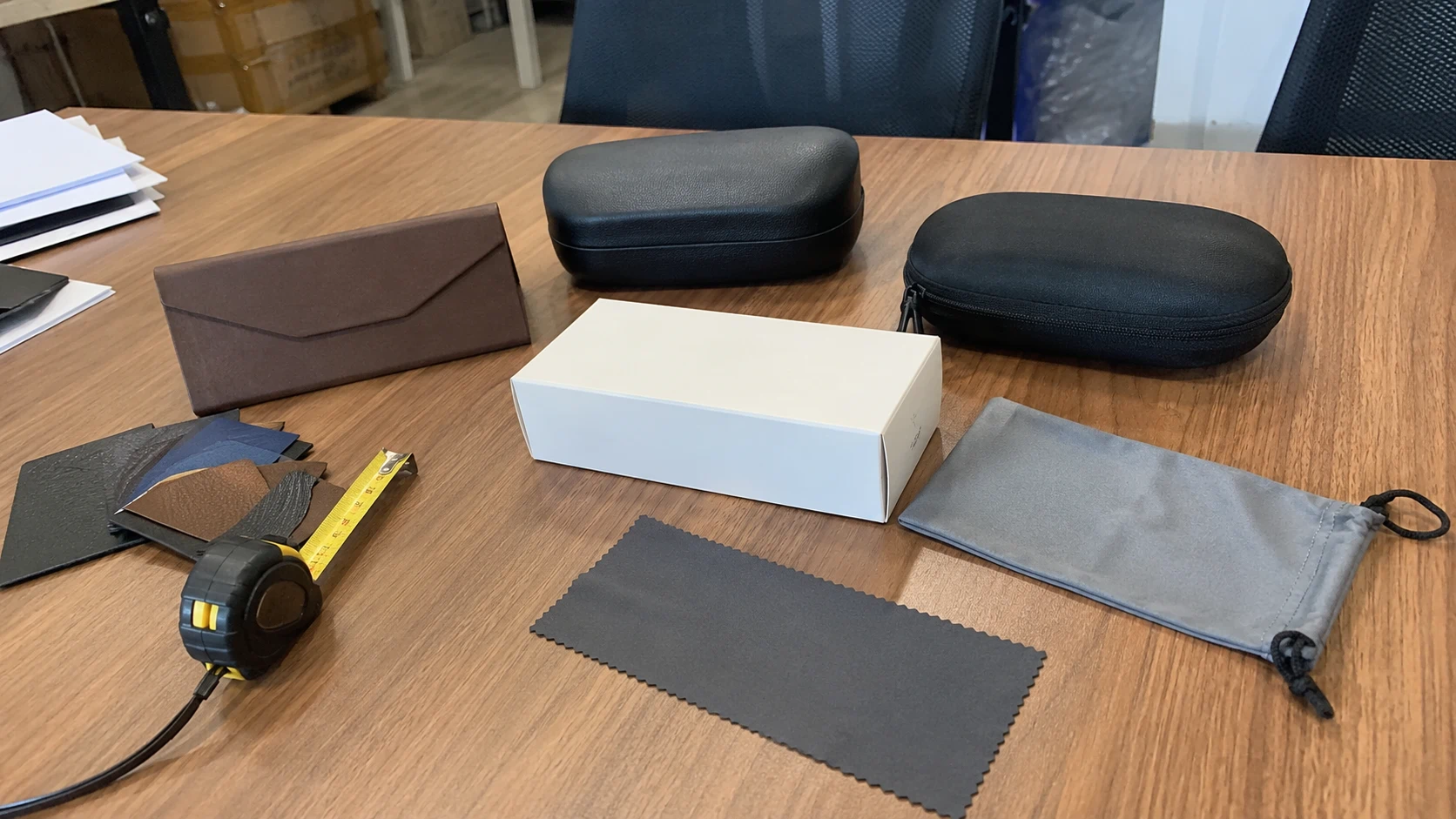
Review the packaging styles alongside their packed specifications, rather than choosing a structure from its appearance alone.

Write down the delivery term and named place
Identify the applicable Incoterms rule and its named place in the quotation. Confirm who arranges each transport stage and who handles the related formalities. A label such as “door to door” is not a complete description of the commercial scope.
Under DDP, the seller has import-clearance obligations and responsibility for applicable import duties and taxes. Whether the seller can fulfill those obligations in a particular destination must be confirmed. The ICC guidance on regulatory barriers explains why local requirements can affect the use of DDP.
Do not assume that one delivery term eliminates every extra charge or changes the requirements applicable to the goods. Ask for exclusions, clearance arrangements and any buyer information needed before dispatch.
Confirm destination-specific import information
Give the forwarder or customs adviser the product description, materials, intended use, origin and destination. Ask them to confirm the classification and applicable costs. A rate quoted for a different product or market is not a reliable substitute.
For packaging documentation, identify the exact materials and destination requirements before production. Review the quality and documentation process with the supplier. This guide does not provide a universal tariff rate or a guarantee of customs clearance.
Agree how changes will be handled
Freight conditions, exchange rates and product specifications can change between the initial inquiry and dispatch. Record the quote validity, currency, shipment scope and the process for approving revised charges.
- What is included in the freight quotation?
- How long is the quote valid?
- Which changes require a new quotation?
- Are special delivery requirements included?
- Who confirms the import information?
- Which documents are supplied, and when?
Worked example: why gross weight is not enough
DHL Express describes volumetric weight as length × width × height in centimetres divided by 5,000, with chargeable weight based on the greater of gross and volumetric weight. Confirm the rules of the actual service and account; do not apply one carrier’s divisor to every shipment. See DHL’s weight and dimensions guidance.
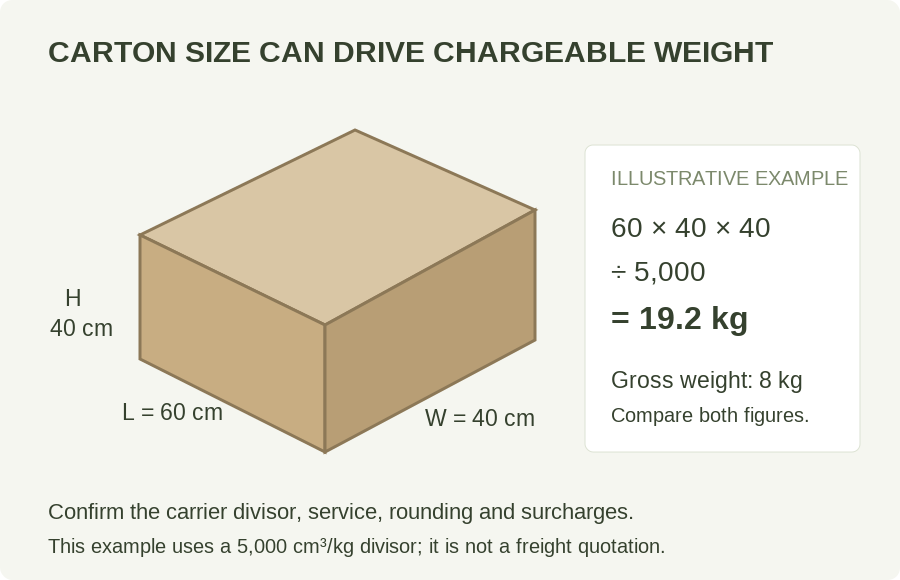
For the illustrated carton, 60 × 40 × 40 ÷ 5,000 gives 19.2kg. If the gross weight is 8kg, the higher figure explains why a lightweight shipment can still carry substantial transport cost under this example service. The illustration is not a price quotation; rounding, surcharges and service terms must also be checked.
Measure the outside of the sealed carton, including bulges where relevant. Ask the packing team to verify the dimensions of the production arrangement rather than relying on an empty-carton specification. For multiple cartons, obtain the weight and dimensions of each carton type.
Compare shipment proposals on the same basis
| Question | Why it matters | Record |
|---|---|---|
| Which route and service? | Transit estimates and charging rules differ | Origin, destination, transport mode and service |
| What is the charging basis? | Gross weight alone may not determine the charge | Actual weight, volume, divisor or other charging basis |
| Which local charges are included? | Origin and destination fees can change the comparison | Included services and exclusions |
| What delivery address? | Appointments and handling needs may affect the scope | Warehouse, retailer, fulfillment center or other location |
| Which validity period? | A proposal may expire before the goods are ready | Expiry date and repricing process |
Reduce empty space without sacrificing protection
Evaluate the case, retail box, individual packing and export carton as one system. Reducing the case dimensions may have little effect if the outer carton remains unchanged. Conversely, removing protection simply to fit more units can create damage and rework costs that outweigh a freight saving.
Ask for two documented packing alternatives: the approved protective arrangement and a proposed improvement. Compare units per carton, external dimensions, gross weight and handling performance. Keep the material and closure details attached to each packing revision.
Where distribution testing is appropriate, a laboratory can help select a programme for the route and shipping unit. ASTM D4169 addresses evaluation of shipping containers and systems against distribution hazards. It is not a blanket certificate for all routes or all case designs.
Keep quotation, production and customs descriptions consistent
Use the same product description, material information, quantity and packing revision in the sales specification and shipping documents. A case described only as “accessory” is less informative than a description identifying its construction and intended use. The broker or other responsible party should confirm classification for the actual goods.
Check the commercial invoice, packing list and any required supporting documents before dispatch. Confirm who supplies the information and who checks it. If a material, accessory or shipment quantity changes, assess whether the quotation or documentation also needs to be updated.
Release the shipment only after the agreed gate
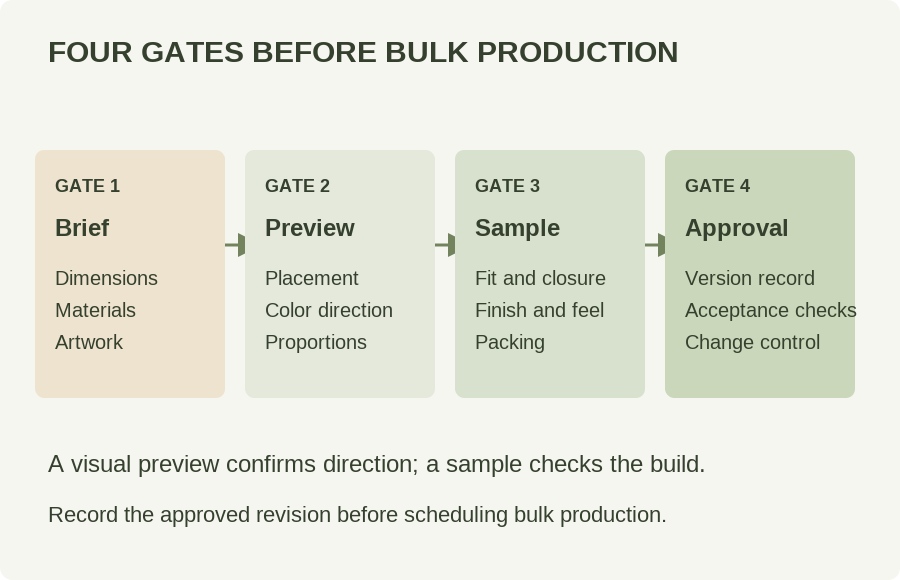
Separate sample approval, production completion, inspection and dispatch. “Production finished” does not necessarily mean that all documents and delivery arrangements are ready. A release checklist should identify outstanding issues and the person responsible for closing each one.
- Approved product and packing revision
- Final carton count, weights and dimensions
- Inspection outcome and resolution of exceptions
- Confirmed delivery term, destination and contact
- Shipping documents reviewed for consistency
- Quote validity and any revised charges accepted
Prepare one brief for all quotations
Send the same quantity, case specification, accessory list, carton information and destination to every supplier or logistics provider. Compare complete scopes before comparing totals. If a line is missing, ask whether it is included, excluded or still awaiting confirmation.
For an initial packaging quotation, use the project contact form and include the required style, quantity, materials and delivery destination.
YOUR NEXT STEP
Turn your packaging brief into a clear plan.
Share your preferred style, quantity, materials and destination. Our team can help confirm the options for your project.
Discuss your project