In this guide
The Hidden ROI of Premium Foldable Eyewear Cases: Maximizing Freight Efficiency Without Diluting Brand Luxury
1. Introduction: The Delicate Balance Between Logistics Costs and Brand Perception
In the highly competitive global eyewear market, procurement managers and brand directors constantly walk a tightrope. On one side, there is the relentless pressure to reduce operational expenses, particularly in cross-border freight and warehousing. On the other side, there is an uncompromising demand to deliver an exceptional unboxing experience that justifies a premium price point. For decades, the industry standard for custom eyewear packaging has been the rigid, bulky clamshell case. While effective for protection, this traditional approach has created a massive, often ignored financial drain: you are essentially paying premium freight rates to ship empty air.
As we look toward the 2025/2026 supply chain landscape, global freight volatility remains a critical concern for B2B buyers. A recent industry supply chain report highlighted that shipping and warehousing can account for up to 15% of a product’s final retail cost if packaging is not optimized. This has prompted forward-thinking brand owners to seek innovative eyewear packaging ideas that do not compromise on aesthetics.
The evolution of premium foldable cases presents a revolutionary solution, offering the perfect synergy between space-saving pragmatism and high-end visual appeal. This comprehensive guide will dissect the hidden ROI of foldable designs, providing actionable strategies to elevate your luxury eyewear packaging while drastically cutting down overhead costs. Understanding this structural shift is the first step toward transforming your packaging from a basic expense into a strategic commercial asset.
2. The “Shipping Air” Dilemma: Why Traditional Packaging Squeezes Profit Margins
Rising global B2B logistics costs have made traditional eyeglass packaging a growing financial burden for many optical brands and wholesalers. When importing rigid hard cases or oversized clamshells, the actual product weight is rarely the main factor in shipping costs. Instead, freight forwarders typically calculate charges based on dimensional weight, also known as volumetric weight. Because standard rigid cases cannot be compressed, shipping cartons end up containing large amounts of unused space. Industry data shows that in a standard shipping container filled with rigid eyewear cases, nearly 70% of the internal volume is essentially trapped air.
This inefficiency directly inflates your eyewear packaging cost. For instance, an eyewear brand shipping 50,000 standard hard cases overseas might require three full 40-foot containers. By failing to optimize the structural design, the brand bleeds capital that could have been reinvested into product development or marketing. Furthermore, this wasted volume translates to a higher carbon footprint per unit, which contradicts the modern consumer’s demand for sustainable corporate practices.
We have seen many brands make this mistake: focusing solely on the unit price of the case while completely ignoring the landed cost. A cheaper rigid case from a basic glasses case manufacturer might save you ten cents on the factory floor, but it will cost you fifty cents extra in freight and customs handling. Recognizing the severe financial impact of dimensional weight is crucial before exploring how different retail channels suffer from this exact same inefficiency.
3. E-commerce vs. Retail Distribution Challenges
The pain points of bulky custom eyewear packaging extend far beyond the initial ocean freight; they severely impact both e-commerce direct-to-consumer fulfillment and brick-and-mortar retail operations. For e-commerce sellers, the “last-mile” delivery is notoriously expensive. Couriers like FedEx, UPS, and DHL heavily penalize oversized parcels. A rigid case requires a larger external corrugated mailing box, extra bubble wrap, and more void fill to prevent movement during transit. This not only increases the postage fee but also drastically slows down the warehouse packing process. Statistics show that reducing parcel dimensions by just one inch can cut last-mile shipping costs by up to 15% annually for high-volume online retailers.
Conversely, retail distribution and optical chain stores face a different set of challenges centered around real estate. Retail square footage is incredibly expensive, and backroom storage space is always at a premium. When wholesale eyeglass cases arrive in bulky formats, store managers are forced to dedicate valuable shelving solely to empty packaging. If a boutique optical shop needs to keep 500 cases in stock, rigid designs will consume entire cabinets, creating logistical headaches and inventory mismanagement.
Retailers prefer brands that provide compact, space-conscious packaging solutions that make restocking seamless. Whether you are scaling an online private label or distributing to hundreds of physical chain stores, the spatial demands of your packaging directly affect your operational fluidity. To resolve these multi-channel distribution hurdles, we must examine the mathematical brilliance behind flat-pack engineering.

4. The Flat-Pack Revolution: Decoding the Volumetric Math
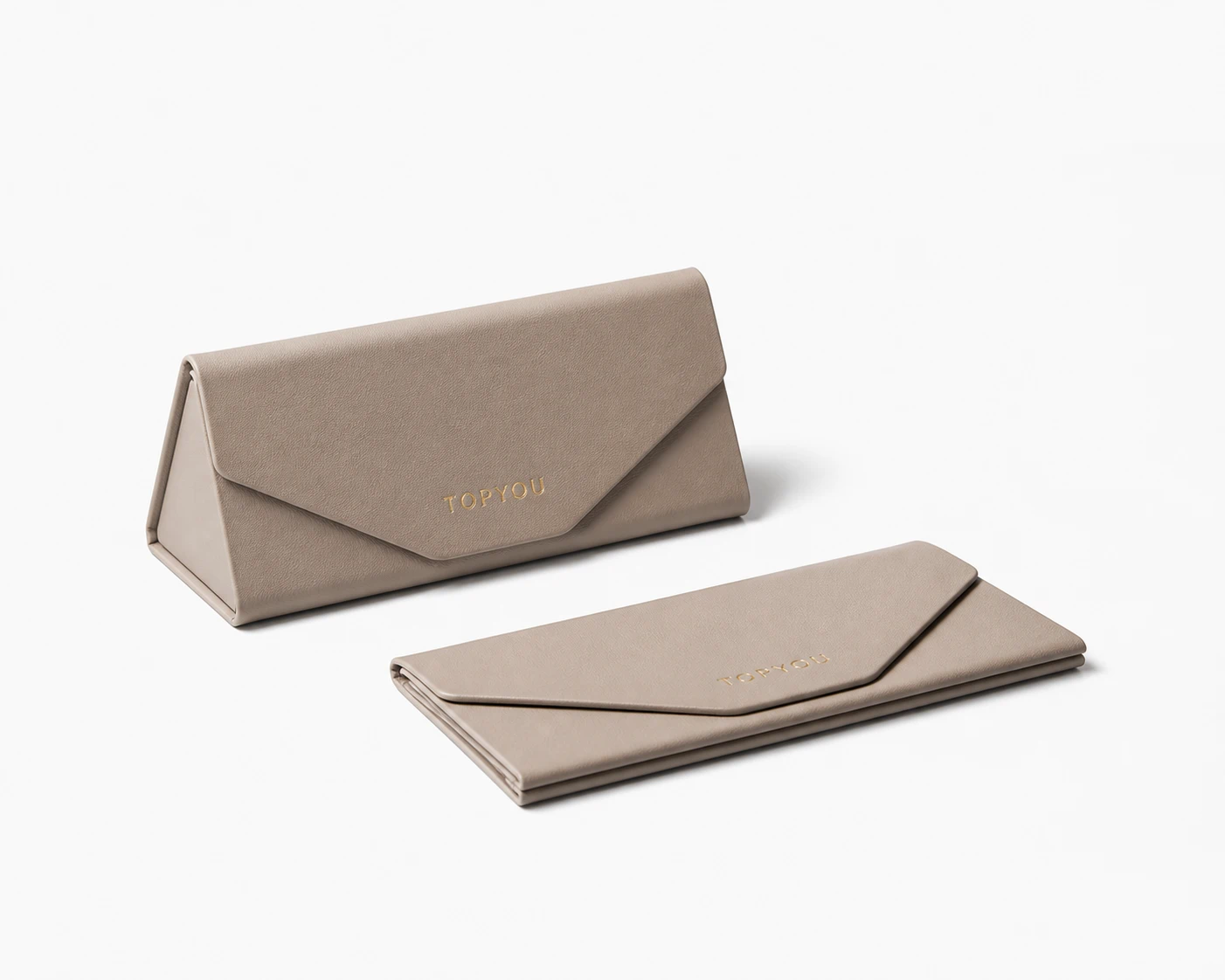
The shift toward foldable geometric structures represents a paradigm shift in how we approach packaging engineering. The core advantage lies in a simple yet powerful volumetric calculation: the 15:1 space-saving ratio. When collapsed, a meticulously engineered foldable case is no thicker than a piece of heavy cardstock. This means that in the exact same footprint required to store one single assembled triangular hard case, you can stack 15 fully flattened cases.
For a brand purchasing from a custom eyeglass packaging manufacturer, this mathematical advantage instantly slashes the volumetric weight of international shipments by 80% to 90%. Instead of requiring three shipping containers for a massive order, the entire inventory can comfortably fit into a fraction of a single container, or even be cost-effectively air-freighted for urgent seasonal launches.
Moreover, this volumetric efficiency triggers a positive chain reaction throughout your entire supply chain, particularly regarding eco-friendly corrugated logistics. Because the primary cases occupy significantly less volume, the master shipping cartons can be much smaller. Smaller master cartons mean less corrugated cardboard is consumed, fewer pallets are required, and less fuel is burned during transportation. This inherently supports eco friendly eyewear packaging initiatives without requiring a complete overhaul of the base materials.
By adopting flat-pack designs, procurement managers achieve dual victories: an immediate and aggressive reduction in inbound freight costs and a measurable decrease in corporate carbon emissions. However, despite these overwhelming logistical benefits, some brand directors still hesitate, fearing that a collapsible structure might compromise the ultimate protection of the eyewear.
5. Dispelling the Myth: Does “Foldable” Mean Flimsy?
The most common objection we encounter from brand managers exploring foldable private label eyewear packaging is the assumption that “collapsible” equates to “fragile.” This is a fundamental misunderstanding of modern packaging geometry. The industry’s leading foldable designs utilize a triangular or prism-based structure. In structural engineering and architecture, the triangle is recognized as the most stable and rigid geometric shape. When a high-quality foldable case is assembled, the internal magnetic closures snap the rigid panels into a locked triangular formation.
This structure effectively disperses external pressure, offering superior impact resistance that rivals, and sometimes exceeds, traditional curved clamshell designs. This robust engineering ensures that the primary goal of the packaging—reducing product return rates due to transit damage—is successfully achieved.
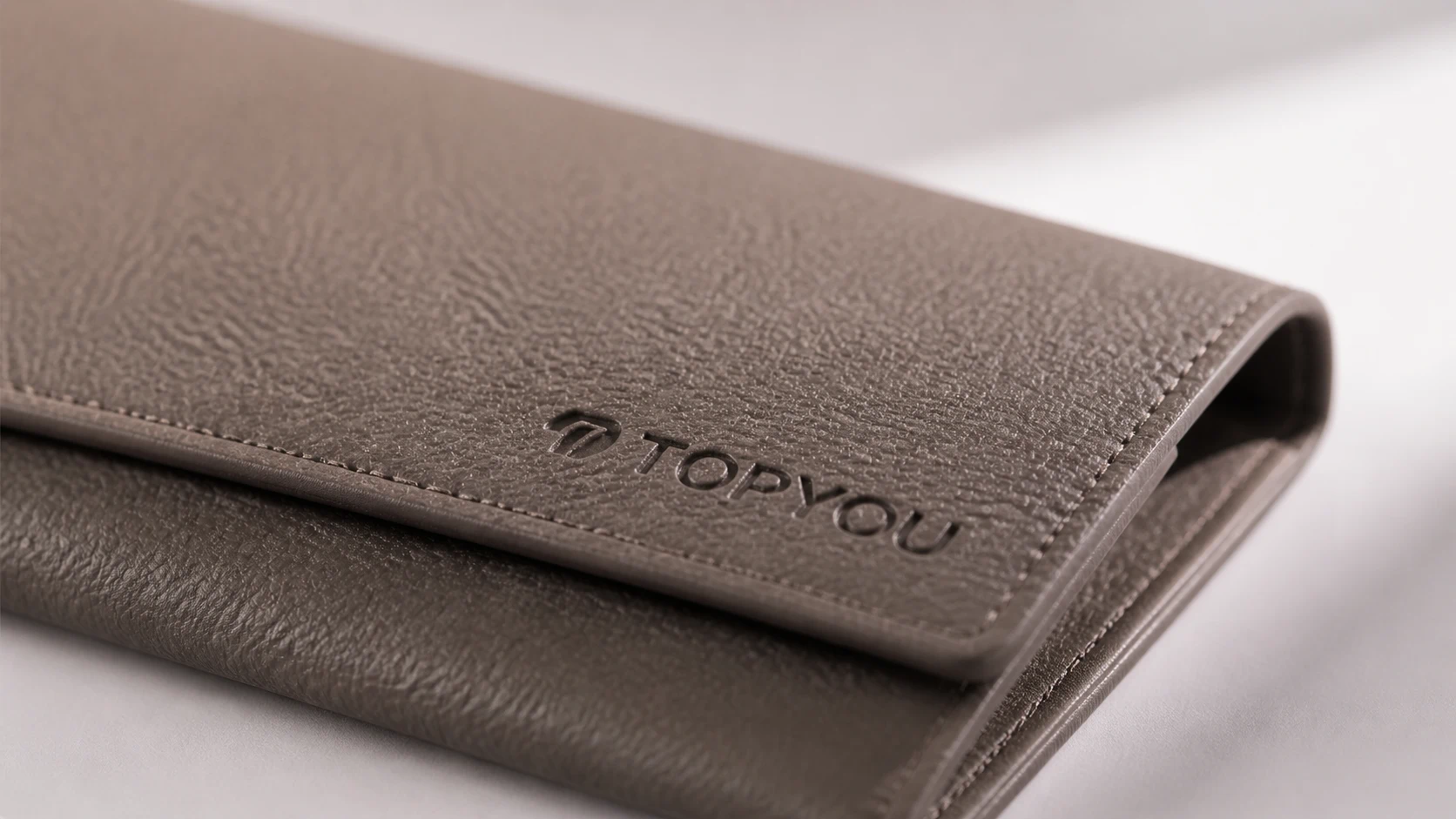
Beyond structural integrity, the tactile experience must convey uncompromised luxury. Premium foldable cases do not rely on cheap plastics; they are crafted using sophisticated material stacking. The exterior often features premium matte vegan leather or textured specialty papers, while the interior is lined with jewelry-class fabric or ultra-soft velvet to prevent lens scratches. The edges are sharply finished, and the hidden magnetic hinges provide a satisfying, heavy “snap” upon closing.
When a customer assembles the case, it feels like an exclusive piece of origami, transforming from a flat plane into a luxurious, architectural statement piece. A reputable partner like TOPYOU ensures that the transition from a 2D flat-pack to a 3D protective shell feels deliberate and high-end, proving that brands do not need to sacrifice a premium unboxing experience to achieve maximum logistical efficiency. Having established that foldable cases offer both strength and luxury, the next step is knowing exactly how to specify and source them correctly.
6. Pro Tips: How to Source the Right Sustainable Foldable Cases
Knowing how to choose eyewear packaging that aligns with both your brand identity and logistical needs requires a strategic approach to sourcing. The 2025 consumer landscape demands transparency and environmental responsibility, making material selection a critical commercial decision. If you are targeting mid-to-high-end retail markets, standard synthetic PU is no longer sufficient. Instead, brands should specify advanced sustainable materials such as Recycled PU or RPET (Recycled Polyethylene Terephthalate) fabrics.
These materials not only divert waste from landfills but also offer the exact same durability, water resistance, and premium hand-feel as virgin materials. Integrating these substrates elevates the perceived value of your product and allows your marketing team to craft a compelling sustainability narrative around your custom logo eyeglass case.
Beyond materials, buyers must rigorously evaluate the structural details provided by their OEM eyewear packaging partner. Pay close attention to the hinge construction and the strength of the built-in magnets. A subpar foldable case will use weak magnets, causing the case to collapse when handled, resulting in a frustrating customer experience and potential damage to the eyewear. Additionally, the core board—the rigid skeleton inside the fabric—must be thick enough to prevent warping but light enough to maintain the freight advantage.
We recommend requesting a “destructive testing” report or a physical prototype from your supplier to personally verify the crush resistance. Securing the right materials and structural guarantees leads us directly to the absolute necessity of navigating global compliance to protect your brand’s reputation.
7. Navigating Global Compliance and Avoiding ODM Customization Mistakes
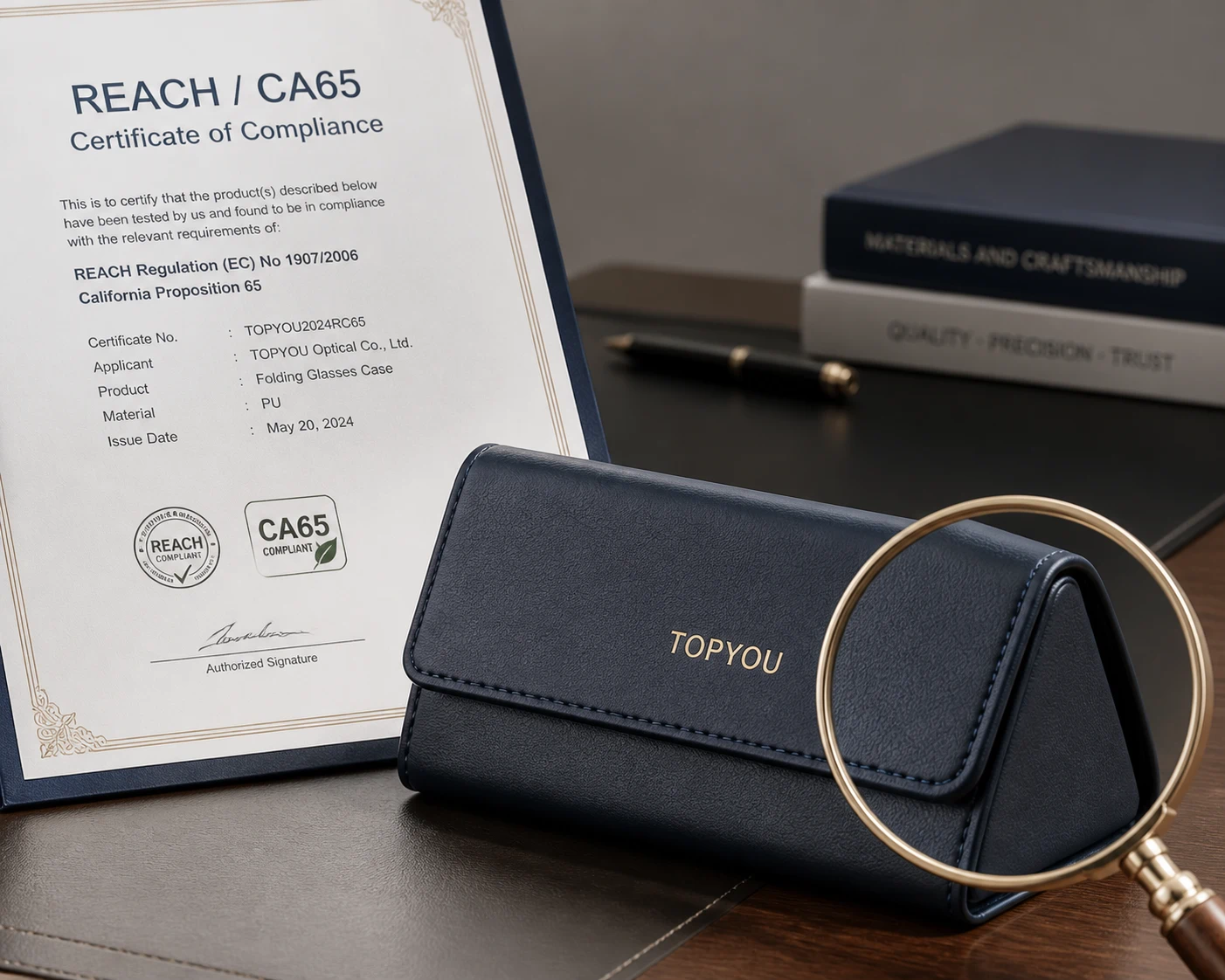
We have seen many brands make this critical mistake: finalizing a beautiful custom design, paying the deposit, and manufacturing the bulk order, only to have their shipment detained at customs due to toxic chemical trace elements in the packaging glue or dyes. For B2B buyers importing into North America or the European Union, strict adherence to global compliance standards is non-negotiable. Your supplier must be able to provide verified certifications such as RoHS, REACH, and CA65.
These certifications guarantee that the vegan leather, microfiber linings, and adhesives used in your packaging are free from heavy metals, phthalates, and other hazardous substances. Partnering with a factory that intrinsically understands and routinely passes these rigorous international tests drastically reduces your legal liability and prevents costly supply chain disruptions.
Furthermore, a lack of deep ODM (Original Design Manufacturer) experience often leads to disastrous customization errors. For instance, inexperienced factories might use an abrasive internal lining that micro-scratches polarized lenses during transit, driving up product return rates and destroying customer trust. Another common failure is poorly engineered folding creases that crack or peel after the case has been opened and closed just a dozen times.
To avoid these pitfalls, it is imperative to collaborate with a seasoned manufacturer that possesses a massive library of validated designs and a dedicated R&D team. A highly experienced supplier acts as a consultant, pre-emptively identifying potential design flaws and suggesting optimal material pairings before mass production begins. By avoiding these costly amateur mistakes, you guarantee a flawless product launch and seamlessly transition into long-term brand elevation.
8. Conclusion: Reimagining Your Eyewear Unboxing Experience
The strategic implementation of premium foldable eyewear packaging is no longer just a clever design trend; it is a fundamental business imperative for any brand looking to scale profitably in the modern retail environment. By transitioning away from outdated, bulky clamshells, procurement managers can instantly unlock massive savings in international freight, warehouse storage, and last-mile delivery costs. More importantly, this logistical efficiency is achieved while simultaneously elevating the end-user’s unboxing experience.
Through advanced geometric engineering, eco-friendly materials like RPET, and rigorous quality control, a flat-pack case delivers the impeccable tactile luxury and robust impact protection that high-end consumers expect. Ultimately, the packaging becomes a powerful statement piece that reinforces your brand’s commitment to both innovation and sustainability.
Selecting the right supply chain partner is the definitive factor in making this transition successful. You need a manufacturer that offers absolute quality stability, robust mass-production capabilities, and deep customization expertise. With 19+ years of dedicated industry experience and a catalog of over 1,500 custom designs, TOPYOU stands as the premier global partner for optical brands and wholesalers. From flexible MOQs starting at 3,000 pieces to seamlessly navigating complex REACH and CA65 compliance, our OEM and ODM capabilities ensure your vision is executed flawlessly. Stop paying to ship empty air and start investing in packaging that actively builds your brand equity.
YOUR NEXT STEP
Turn your packaging brief into a clear plan.
Share your preferred style, quantity, materials and destination. Our team can help confirm the options for your project.
Discuss your project