In this guide
Eyewear packaging documentation is useful only when it can be traced to the product being ordered. A general certificate, a supplier’s sustainability statement and a laboratory report answer different questions. Start by identifying the product, its material layers, the destination and the party responsible for placing it on the market.
Define the product before requesting a certificate
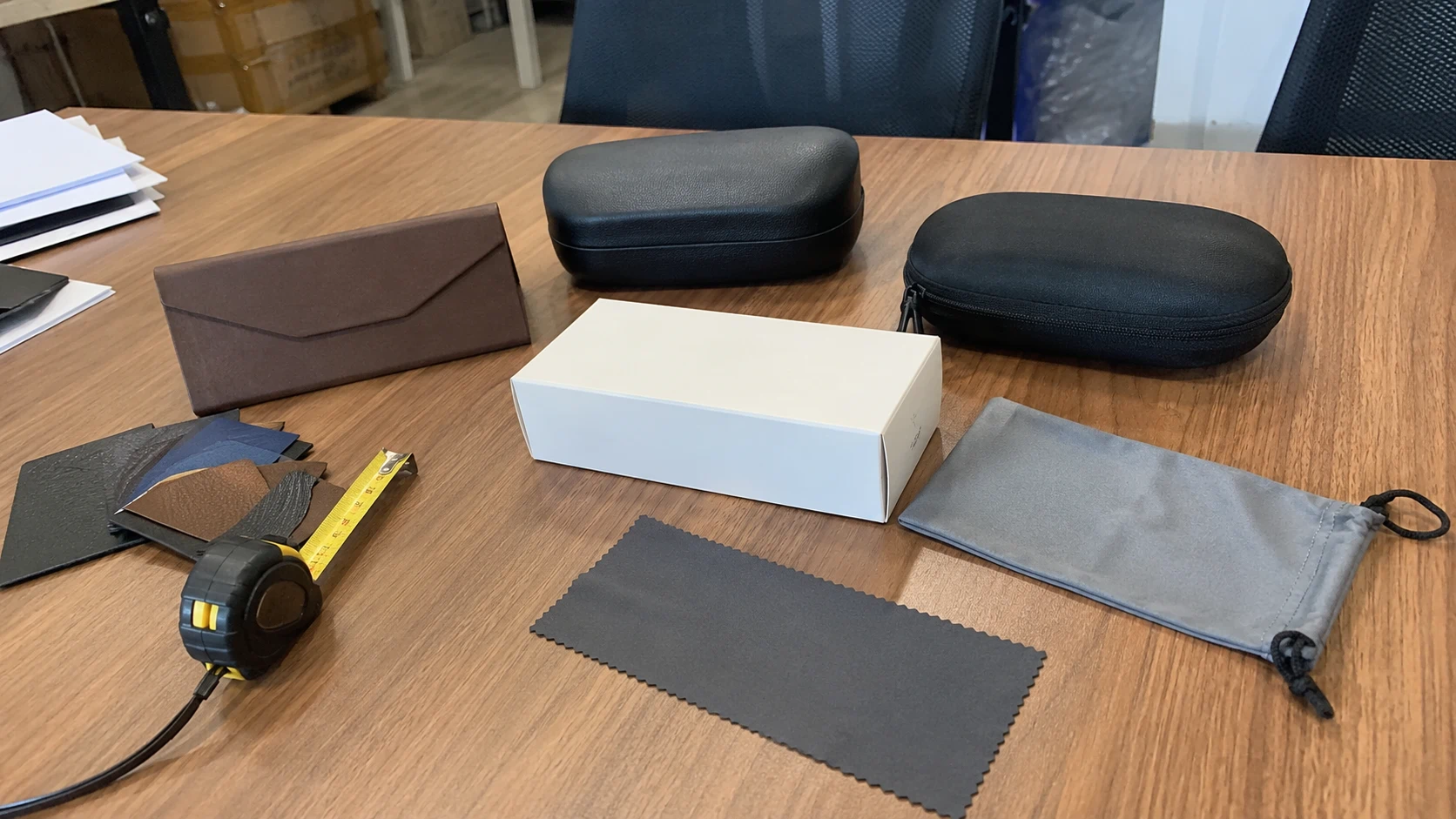
Prepare a component list covering the case, cover, lining, adhesive system, hardware, paper box, cloth, pouch, labels and export packing. Identify the product model, specification revision and material codes. This prevents a report for one material or model being treated as evidence for an entire packaging set.
Also confirm the intended use of each item. A reusable case, retail box and transport carton are not interchangeable descriptions. The applicable requirements need to be assessed for the actual product and market, including whether a component is treated as packaging in its intended use.
Separate the regulatory questions
| Topic | Question to resolve | Evidence to request |
|---|---|---|
| EU packaging rules | Which packaging requirements and implementation dates apply to this component and use? | Component specification and a market-specific requirement assessment |
| REACH material information | Which substance restrictions or article-information obligations are relevant? | Traceable supplier declarations and targeted supporting evidence |
| California Proposition 65 | Could the product cause a relevant exposure, and is a warning required? | A product-specific assessment and supporting information |
| RoHS or a brand’s restricted-substance policy | Is this a legal scope requirement or a separate procurement request? | The buyer’s requirement and a test scope matched to it |
| Recycled-content claim | What material and proportion is the claim about? | Evidence matching the component, supplier and stated claim |
Understand the 2026 EU packaging timeline
The European Commission states that Regulation (EU) 2025/40 entered into force on 11 February 2025 and has an application date of 12 August 2026. Its requirements are phased; the application date does not mean every future requirement has the same deadline. Use the Commission’s packaging overview and PPWR FAQ to identify the relevant provisions.
For procurement, turn that assessment into a written requirement list. Identify the component, requirement, responsible party, evidence needed and approval date. Registration, reporting or other producer-responsibility arrangements should be confirmed for the market and supply chain rather than assumed from a factory test report.
Treat REACH evidence as material-specific
ECHA explains that Candidate List substances in articles can trigger obligations for producers, importers and suppliers, and that supply-chain information is important in identifying their presence. See ECHA’s official article guidance. Ask which material and component the declaration covers and which substance list or test scope was used.
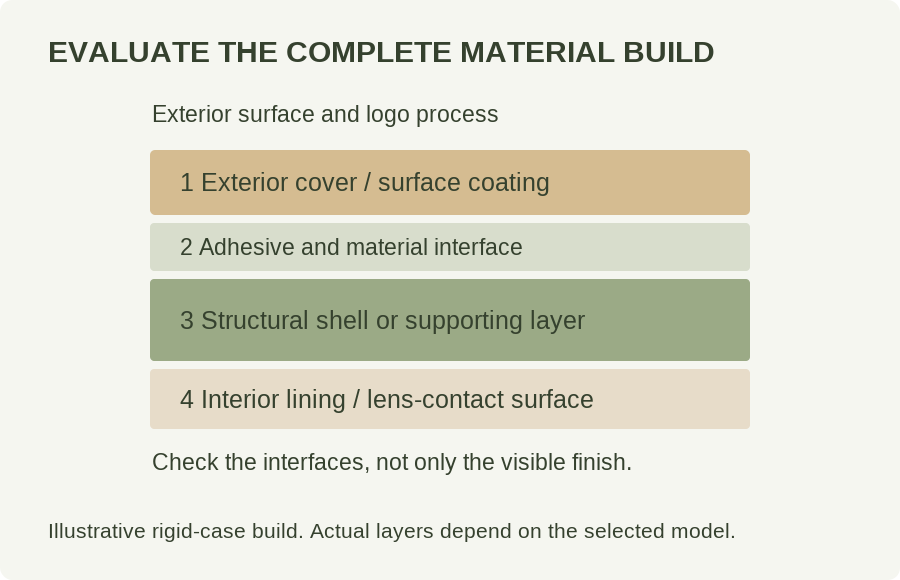
Record the supplier, material code, declaration date and product revision. A test on an exterior cover does not automatically establish the composition of the lining, adhesive, metal component or printed accessory. If the product changes, assess whether the evidence still represents it.
Do not confuse chemical presence with a Proposition 65 conclusion
Proposition 65 concerns exposure to listed chemicals and the circumstances in which warnings are required. A statement that a chemical was detected is not, by itself, a complete warning assessment. The OEHHA business guidance describes the exposure-based framework.
Give the responsible reviewer the intended use, materials, relevant product data and any available laboratory results. Record the scope and conclusion of the review. Avoid requesting or advertising a generic “CA65 certificate” as though it proves every use and exposure condition.
Distinguish RoHS scope from a buyer’s test request
The EU RoHS Directive addresses hazardous substances in electrical and electronic equipment. Ordinary non-electrical packaging is not automatically within that scope simply because it accompanies eyewear. A brand can still request a restricted-substance test as a procurement condition; record that separately from a legal applicability assessment.
Intertek and other laboratories are testing or conformity-assessment providers, not regulations. Ask for the actual method, substances, sample identification, results and acceptance basis. The laboratory’s name alone does not define what has been demonstrated.
Review the report, not just the cover page
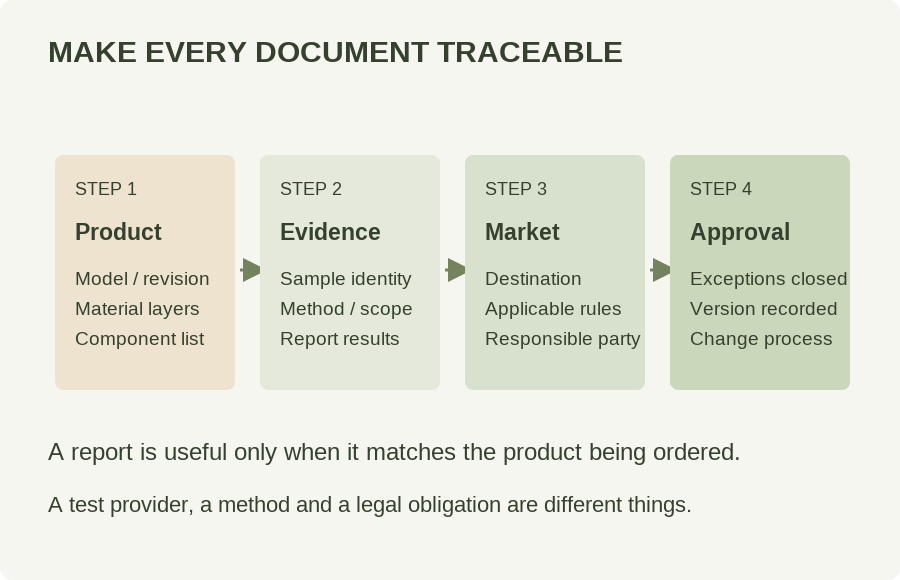
- Identity: Does the sample description match the selected product and material revision?
- Scope: Which components, substances or performance properties were evaluated?
- Method: What method and conditions were used?
- Results: Are the measured results and any relevant limits stated?
- Exceptions: Are exclusions or qualifications visible?
- Traceability: Can the report be connected to the supplier and ordered batch or specification?
- Changes: What will trigger renewed review or testing?
Keep an approval register for the packaging set
| Record field | Example of the information needed |
|---|---|
| Component and revision | Selected case model, lining code and approved construction revision |
| Destination and requirement | Named market and the requirement assessed for that component |
| Evidence | Declaration or report reference, sample identity and scope |
| Review status | Approved, awaiting evidence or requiring correction |
| Owner | The party responsible for supplying and reviewing the evidence |
| Change control | Material or design changes requiring reassessment |
Connect this register to the approved sample and order specification. Close unresolved issues before production release or dispatch, according to the agreed project process. A clear evidence chain is more valuable than a collection of unrelated certificates.
For a project discussion, review the quality and testing overview and provide the exact product, materials and destination through the contact page. This procurement checklist helps organize the information; product-specific legal obligations must be assessed using the applicable rules and responsible market parties.
YOUR NEXT STEP
Turn your packaging brief into a clear plan.
Share your preferred style, quantity, materials and destination. Our team can help confirm the options for your project.
Discuss your project